



On the night of 10 September 1954, Marius Dewilde reported a disturbing encounter beside a railway at Quarouble, near Valenciennes in northern France. Two small figures, a dark mass on the track and a dazzling light became the basis of a celebrated landing story. Contemporary coverage preserves a more complicated sequence than a single settled narrative. The earliest papers describe an alarming experience; within days, headlines were announcing physical evidence. Those are different kinds of claim, and their changing presentation is central to the case.
The map uses a broad Quarouble reference, rounded to 50.39°N, 3.62°E from the checked commune coordinates. It deliberately does not identify a private home or reconstruct an exact position on the railway. The photograph shows the town hall in 2010, providing locality context rather than a view of the reported encounter.
The first account: a frightening light
The original Nord-Matin report of 12 September describes Dewilde as a metalworker. A barking dog brought him outside at about 10.30 p.m. He initially thought he might be seeing intruders or smugglers. Two short, bulky figures passed nearby, with something reflecting light at head level. A separate dark mass suggested an abandoned cart. This starting point matters: familiar possibilities preceded the extraordinary interpretation.

In the continuation on page 8, he describes a light like a magnesium flash. The newspaper says fear immobilised him. As the opening closed, the object allegedly rose about ten metres and moved towards Anzin with a red glow. The paper also reports shaking and contractions when he reached the commissioner. Its sympathetic assessment of his behaviour supports the reporter’s impression of sincerity, rather than independently establishing what produced the light.

What another early newspaper recorded
The La Voix du Nord article of 12 September, page 3, gives the time as about ten o’clock. It describes an oval, domed mass, estimated at six metres across and three high. Dewilde reportedly approached the two figures, then saw a brilliantly lit square opening. He closed his eyes; when he looked again, the light had gone and the object was rising, with smoke and a red underside. These descriptions are attributed recollections and estimates, not surveyed dimensions.

That report places his wife’s involvement after the experience: he went to wake her. It also says police examining the surroundings on Saturday morning found no trace. An Air Police visit followed in the afternoon. The distinction prevents two common shortcuts. His wife’s presence at the home does not make her an eyewitness to everything he described, and a reported investigation does not itself prove a landing. The same newspaper page carries a separate Amiens sighting, which must not be counted as another view of the Quarouble encounter.
From no traces to reported marks
A France-Soir dispatch dated 14 September and published on the 15th changes the emphasis. It says three Air Police inspectors returned the previous day and left persuaded that an unusual object had landed. The article describes five damaged positions on a wooden sleeper. Three central marks were said to be separated by 43 centimetres, with the outer pair 67 centimetres from the preceding marks. An inspector is quoted interpreting these as supports rather than wheels.

The page 6 continuation cites reports of a red light from people elsewhere in the district, while also acknowledging scepticism. Neither a distant light nor a newspaper’s diagram independently verifies the small figures. More fundamentally, this is a journalist’s report of inspectors’ findings. The original signed inspection, photographs with a documented sequence, and a technical demonstration of the marks’ cause are not supplied by the clipping. The measurements therefore remain reported measurements, not a verified calculation of a vehicle’s size or weight.

A reporter returns to the scene
Special correspondent Michel Duforest’s Nord-Eclair article of 16 September describes six claw-like marks arranged in a semicircle and a hard material apparently rubbing against wood. That count differs from France-Soir’s five positions. The accompanying photograph shows Dewilde indicating the sleepers; a caption is an interpretation of the scene, rather than a test establishing what made a mark.

In the continuation, Duforest interviews Dewilde and the commissioner. He takes the witness’s sincerity seriously but discusses a possible waking hallucination rather than treating the account as settled evidence of visitors. The commissioner describes going to Dewilde’s bed at daybreak. This differs from Nord-Matin’s description of a midnight meeting. Such discrepancies need preserving: collapsing the articles into a smooth composite would hide the very differences a later investigator needs to assess. None of these press accounts gives a controlled before-and-after record of the railway timber.

Scepticism was contemporary too
The Liberté report of 12 September, page 4, already treated the episode sceptically. It retold the figures and departing object with ridicule and attacked the influence of films, radio and sensational reporting. This is useful evidence of the contemporary debate. Its editorial confidence is not an experiment demonstrating a particular explanation, any more than a sympathetic headline proves a spacecraft. The disagreement existed from the beginning; it was not simply a later discovery imposed on an initially unanimous investigation.

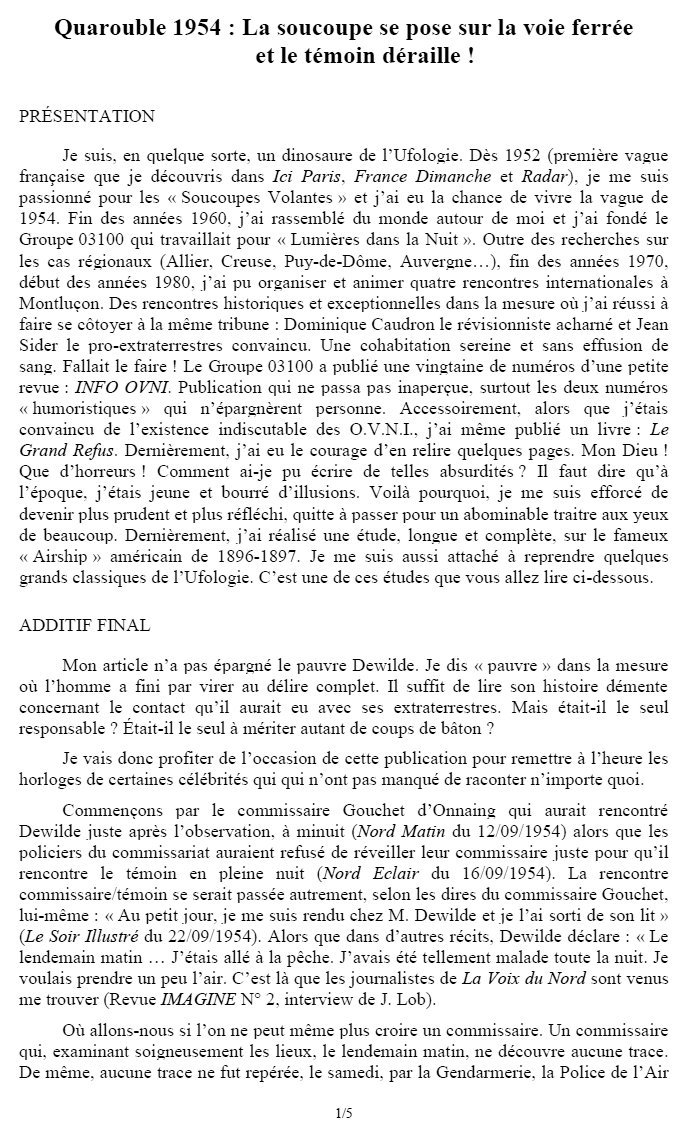
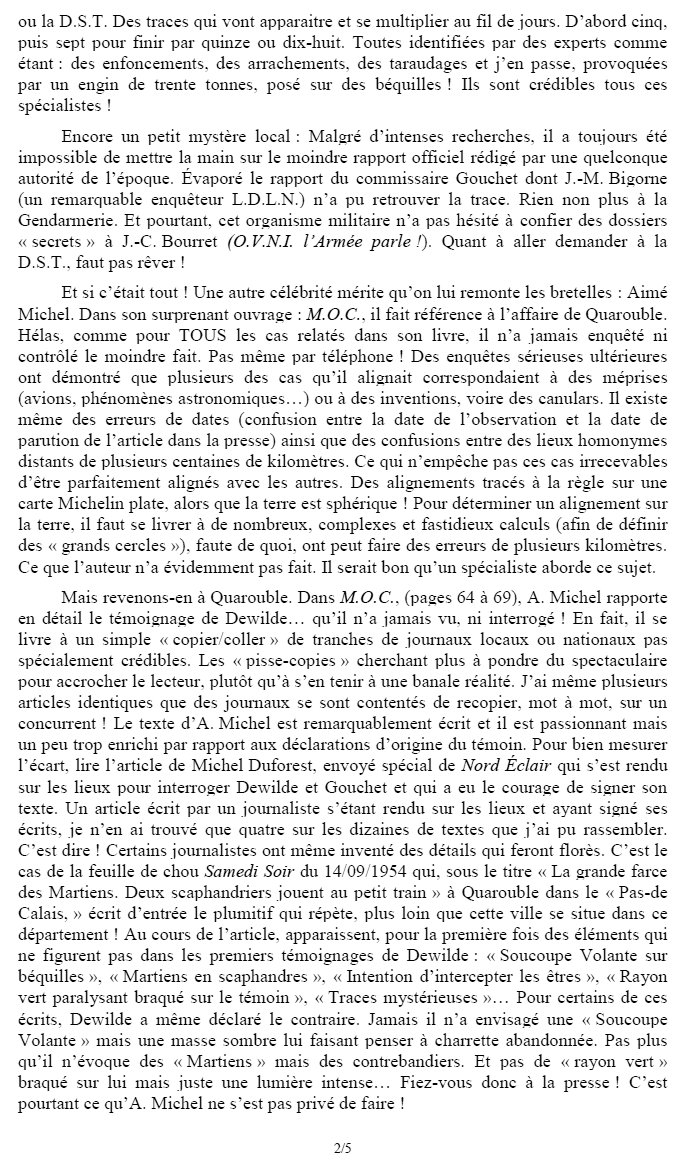
In a much later 2024 critical essay, researcher Jean Giraud returned to the press trail. On page 2, he argues that repeated newspaper material had been mistaken for independent confirmation, and reports unsuccessful attempts to locate original official documentation. His criticism is a retrospective source assessment, seventy years after the event. Failure to locate a report does not demonstrate that it never existed. It does identify a concrete limit on claims that an official investigation conclusively verified the story.
What the record supports
Quarouble is well documented as a reported experience and a rapidly developing newspaper story. The original clippings support the date, the witness’s attributed account and the existence of public disagreement. They also preserve changes in the language of paralysis, differences in the chronology and competing descriptions of alleged traces. Their survival makes those comparisons possible; it does not resolve the physical cause. A cautious account leaves that cause unestablished, while refusing to replace the early evidence with either a confident alien narrative or an unsupported diagnosis of the witness.