

On 1 December 1946, eighteen-year-old Bennington College student Paula Welden left campus for a hike and did not return. Her disappearance prompted extensive searches and exposed shortcomings in Vermont’s police arrangements. Decades later, it became a central story in the so-called Bennington Triangle. The surviving accounts distinguish an unsolved missing-person investigation from the later suggestion that several regional disappearances shared an extraordinary cause.


What the police record establishes
The Vermont State Police’s current case summary identifies the afternoon of 1 December as the last time Welden was seen. It says she told her roommate that she was going hiking and was reported missing the following morning after failing to return. Several hikers reported seeing her on the Long Trail just off Route 9 near Glastenbury Mountain.
The agency says an extensive search found no sign of Welden. Investigators from New York, Massachusetts and Connecticut assisted because Vermont’s police services were limited. Numerous theories were investigated, but no conclusive outcome was determined. The present public summary is brief: it does not reproduce the original witness interviews, search maps or complete investigative file. Its value is as the responsible agency’s continuing account of the unresolved case.
The afternoon reconstructed later
Corin Hirsch’s 2011 Seven Days feature, Missing!, gives a more detailed retrospective chronology. It places Welden’s departure after her dining-hall lunch shift at approximately 14:30, followed by a lift from a passing motorist around fifteen minutes later. According to that account, she said she intended to hike the Long Trail; a fellow hiker reported speaking with her around 16:00 about how far the trail continued.
Those clock times come from later reporting, rather than a new examination of original interview records for this article. They help outline the reported journey but should not be treated as a continuously observed route. The police summary and the retrospective account both place the disappearance in Vermont. Her family’s home in Stamford, Connecticut, is background, not the incident location.
An early newspaper account and conflicting identifications
A contemporary Bennington Evening Banner clipping dated 4 December 1946, reproduced by Vermont Public, shows how the search developed. It reports a shift in attention from Mount Anthony to the Woodford area after newspaper night watchman Ernie Whitman recognised Welden’s photograph. He said that a young woman had asked him about the Long Trail at about four on Sunday afternoon. The report says companions were also questioned and their descriptions agreed.
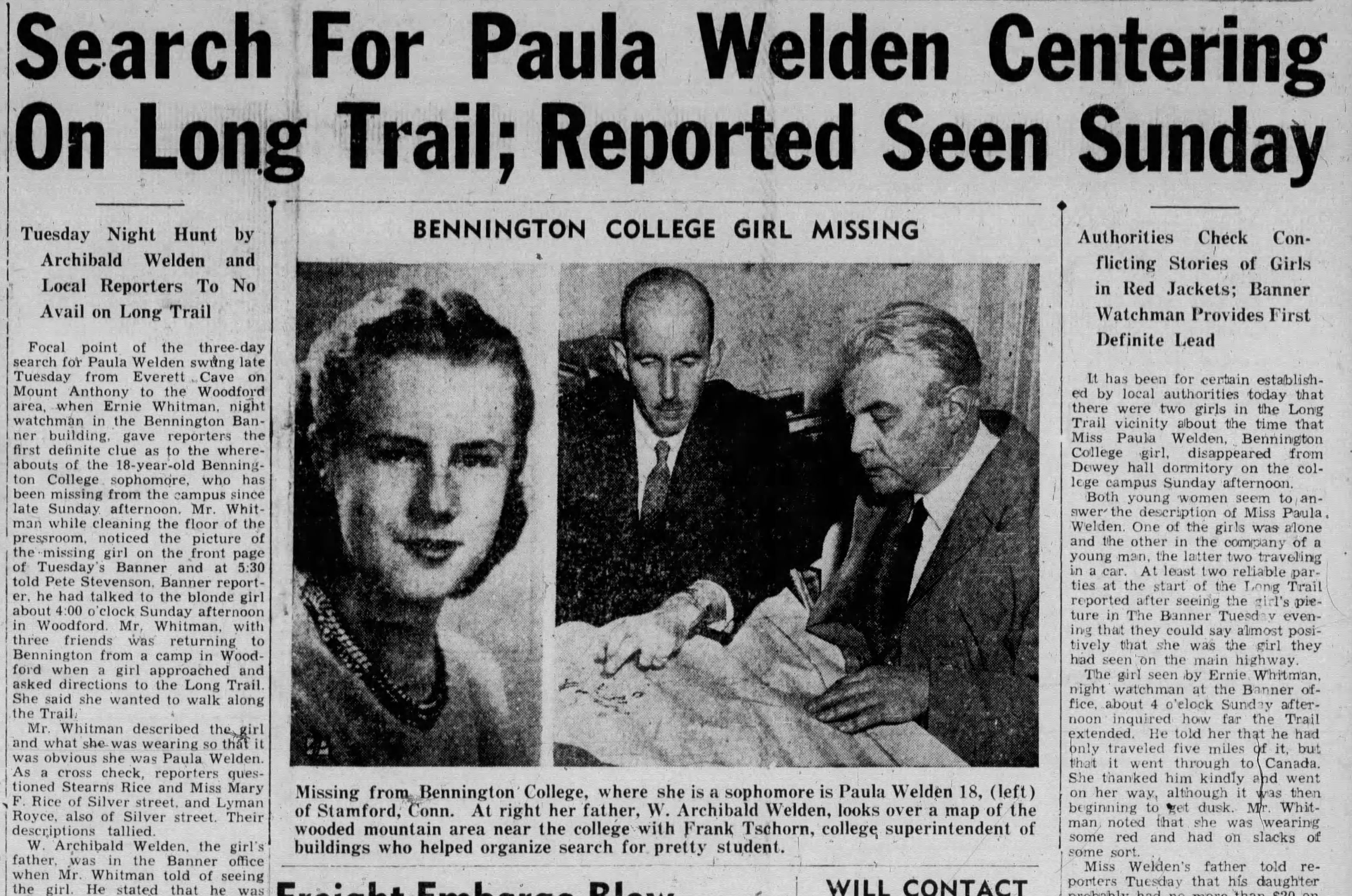
The adjoining column is more cautious than a simple last-sighting narrative: authorities were checking reports of two young women in red jackets in the area. A photograph showed Welden’s father examining a map with the college’s superintendent of buildings. This is contemporary evidence of an active search and attempts to distinguish witnesses’ identifications. The clipping is not proof of Welden’s subsequent route or fate, and the reproduced portion does not contain every continuation of the newspaper report.
A consequence for Vermont policing
The police agency links the Welden investigation to its establishment in 1947. Don Keelan’s 2022 VTDigger anniversary commentary supplies institutional context: Act 163 created the Department of Public Safety and a state police force, and Merritt Edson organised an initial body of fifty-five troopers. Keelan presents the poorly coordinated Welden search as a conspicuous illustration of the need for a trained statewide agency.
That is a consequential historical connection, not a solution to the disappearance. Better organisation after 1946 could not retrospectively supply observations or physical evidence that had never been secured. The case’s role in police history should remain distinct from claims that investigators established a particular explanation.
How the Triangle story developed
In Vermont Public’s 2025 Brave Little State investigation, Howard Weiss-Tisman interviews author Joe Citro about the name Bennington Triangle. Citro dates its introduction to a 1992 radio commentary and explains the deliberate echo of the Bermuda Triangle. He also acknowledges adding fanciful material he did not believe, including suggestions involving aliens and a man-eating rock.
The programme interviews state police Captain J. P. Schmidt, who is sceptical of a common otherworldly explanation and discusses how difficult remains can be to recover in wooded mountain terrain. That is an investigator’s assessment of the broader narrative, not a determination that Welden died in a particular place or manner.
The cluster also needs qualification: one of the other people commonly included, Frieda Langer, was found dead the following spring. The familiar account of five people all disappearing permanently without a trace is therefore inaccurate. Grouping cases under a memorable regional name does not establish that their causes were connected.
Following the archival trail
Bennington Museum’s public history-biography finding aid, on PDF page 127, lists a Paula Jean Welden file. Its contents include Mary Baillie’s three 2000 Banner retrospectives, Tim Powers’s 1976 anniversary article and Rebecca Robinson’s 2006 account, alongside material about later Triangle interpretations. The catalogue is useful for identifying specific research leads rather than relying on anonymous repeated summaries.
The finding aid is an inventory, not the contents of the file. Those listed articles have not all been independently examined here, and their titles do not establish the truth of a proposed crime or other explanation. No private investigative records or personal submissions were accessed for this account.
Assessment
The outcome is Insufficient evidence to determine what happened to Welden. The responsible police agency continues to describe an unresolved disappearance; the public sources do not establish her fate. The uncertainty does not verify murder, voluntary departure, an accident or a paranormal cause, and this article makes no allegation against a named suspect.
The strongest distinction is between evidence about the search and evidence about the disappearance. A contemporary report can show where investigators looked and why they followed a lead. A later interview can explain how a regional legend was named. Neither, by itself, supplies the missing link from Welden’s reported afternoon walk to a demonstrable outcome.
Location and illustration
Location note: the pin uses a rounded Census reference for Woodford town, Vermont, the search locality named in the contemporary clipping. It is an approximate area reference, not a precise last-seen coordinate, reconstructed route, grave or visitor destination. The location is not presented as a public attraction and confers no access permission.
The photograph shows Glastenbury Fire Tower and a Forest Service utility vehicle in July 2024. It illustrates the wider mountain area only; the reviewed sources do not establish that Welden reached that tower. Its modern date is unrelated to the incident year. Coordinates come from the Census Bureau’s Vermont county-subdivision Gazetteer, rather than a guessed spot on the Long Trail.