

Chūgorō’s colleagues notice two things: the young retainer leaves his employer’s residence every night, and he is becoming pale and weak. What appears to be a private love affair turns into a story of an underwater marriage, a broken promise and a fatal encounter with a deceptive spirit. The final explanation is deliberately unexpected, overturning the lover’s own belief that he may have met a divine woman.
Lafcadio Hearn includes “The Story of Chūgorō” in Kottō. The digitised edition reviewed here carries a 1903 title page. Hearn introduces its opening group of nine tales as selections from old Japanese books, intended to illustrate strange beliefs. He does not present this story as an encounter he investigated or a medical case whose records he examined.
A retainer in old Koishikawa
The narrative places Chūgorō in the Koishi-kawa quarter of Yedo, the historical city now called Tokyo. He serves a hatamoto named Suzuki, whose residence stands beside the river Hearn calls the Yedogawa, near Naka-no-hashi. Chūgorō is an ashigaru, a member of the lower-ranking military household staff; a note in the book explains the term.
For years he is regarded as capable, pleasant and dependable. His nightly absences initially attract little concern because they do not interfere with his duties. Once his health begins to deteriorate, an older retainer takes him aside. The man warns that the household’s senior officer may need to be informed unless Chūgorō explains what is happening.
Chūgorō agrees to tell him, but insists on secrecy. In his account, the affair began roughly five months earlier, in the first part of spring. These relative dates supply a sequence within the story, not a calendar year. The setting’s old social terms likewise provide historical atmosphere without securely dating the alleged episode.
The woman beside the river
Returning from a visit to his parents one evening, Chūgorō sees an elegantly dressed young woman standing alone near his employer’s gate. She catches his sleeve and asks him to walk towards the bridge. She says that she has watched him entering and leaving the residence, has grown fond of him and wishes him to become her husband.
Near the bridge she leads him down the bank and asks him to enter the water. He knows that it is deep and becomes afraid. When she takes his wrist, however, he feels unable to resist. The next thing he remembers is walking beside her through a brilliantly lit palace. Neither of them is wet or cold. The unexplained passage into this place is part of his reported experience within the narrative, rather than a described journey that can be reconstructed.
They pass through many empty rooms to a great chamber prepared for a feast. Servants bring food and rice wine, and the woman announces that this is their wedding night. They pledge themselves across seven existences. Chūgorō thinks of Urashima, the familiar story of a man visiting an extraordinary underwater realm, and wonders whether she might be a god’s daughter.
The secrecy of the marriage
Before dawn, the woman wakes him and explains that their marriage must remain hidden. She will not tell him why, and says that keeping him there until daylight would endanger them both. He must return to his lord’s residence and meet her at the bridge at the same time every following evening. She warns that disclosure may separate them permanently.
Chūgorō promises obedience. When she takes his wrist again, darkness intervenes and he finds himself alone on the river bank. He reaches the residence before the temple bells sound. He tells his older colleague that the same nightly meetings and unexplained transitions have continued ever since. His apparent decline has not persuaded him to stop visiting her.
The older man interprets this as a possible enchantment. He believes the younger retainer’s sincerity, but suspects that an evil power is producing an illusion for a harmful purpose. He promises silence while Chūgorō remains alive and well, and warns him to be careful. That warning is the character’s assessment of the tale’s events; it is not an independent investigation supplied by Hearn.
The failed meeting and the physician
That night Chūgorō returns unusually early and distressed. The woman has not appeared at the bridge. He believes that telling his secret has caused her to abandon him. His colleague tries to reassure him, but Chūgorō falls silent and begins trembling.
At dawn he collapses while trying to rise. A physician is summoned, examines him and declares that his veins contain water rather than blood. Treatment fails, and he dies at sunset. The story supplies neither an examination record nor a description of a laboratory test. Its medical language works as a supernatural revelation inside the plot, and should not be repeated as an established physiological finding.
After Chūgorō’s death, the older retainer tells the physician about the marriage. The doctor claims to recognise a being that has haunted the river since ancient times and is attracted to young people’s blood. The retainer asks whether she is a fox woman, then a serpent or dragon woman. The physician rejects each suggestion and identifies the creature as a great frog, whose ordinary daytime appearance would be repellent.
The story’s reversal and its evidence
This ending changes how the earlier splendour is read. The lavish palace and beautiful bride, which Chūgorō associates with divine romance, become disguises in the physician’s explanation. His promise of secrecy prevents his companions from understanding his decline until it is too late. The narrative combines attraction, isolation and mistaken recognition rather than simply describing a frightening figure seen at a distance.
The surviving source supports this particular literary account and its Koishikawa setting. It does not establish a named patient’s death from an unknown cause, a physician’s verified diagnosis or the existence of a blood-taking frog spirit. The outcome is therefore insufficient evidence for the supernatural events. Calling it folklore preserves its historical value without presenting its final identification as a demonstrated zoological or medical explanation.
Location and historical illustration
The map is a broad Koishikawa quarter reference from GeoNames 8573193, rounded to 35.71, 139.75. Suzuki’s residence and the bridge in Hearn’s narrative have not been independently located. The old river name is retained as written, without moving the story to another modern river or bridge merely because the name resembles it.
The official Tokyo Parks page confirms that Koishikawa Kōrakuen is a public historic garden in the wider district, but it does not identify it as Suzuki’s residence or connect it with Chūgorō’s story. It has therefore not been designated a case visiting site. No public access to the narrative’s actual premises is established.
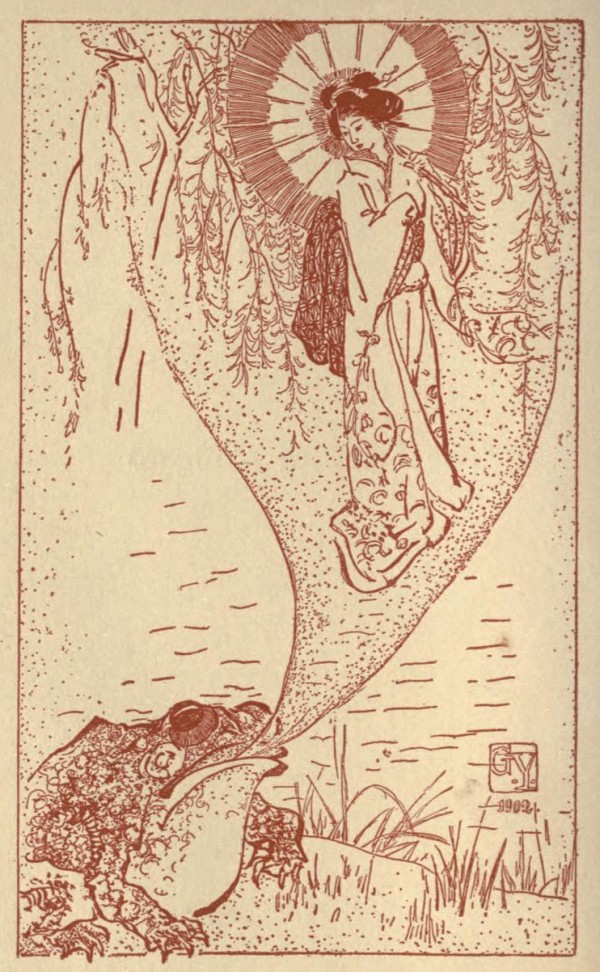
The lead image is Genjiro Yeto’s historical chapter illustration, showing a frog and an elegantly dressed woman. It is clearly a literary illustration, not a photograph of an encounter. The complete story, its ashigaru note and Hearn’s introduction to the nine old tales were read; no earlier Japanese version was independently collated. Related Hearn narratives include Aoyagi’s willow-wife story, another tale in which a relationship depends on a concealed nonhuman identity.