
What Is a REM Pod?
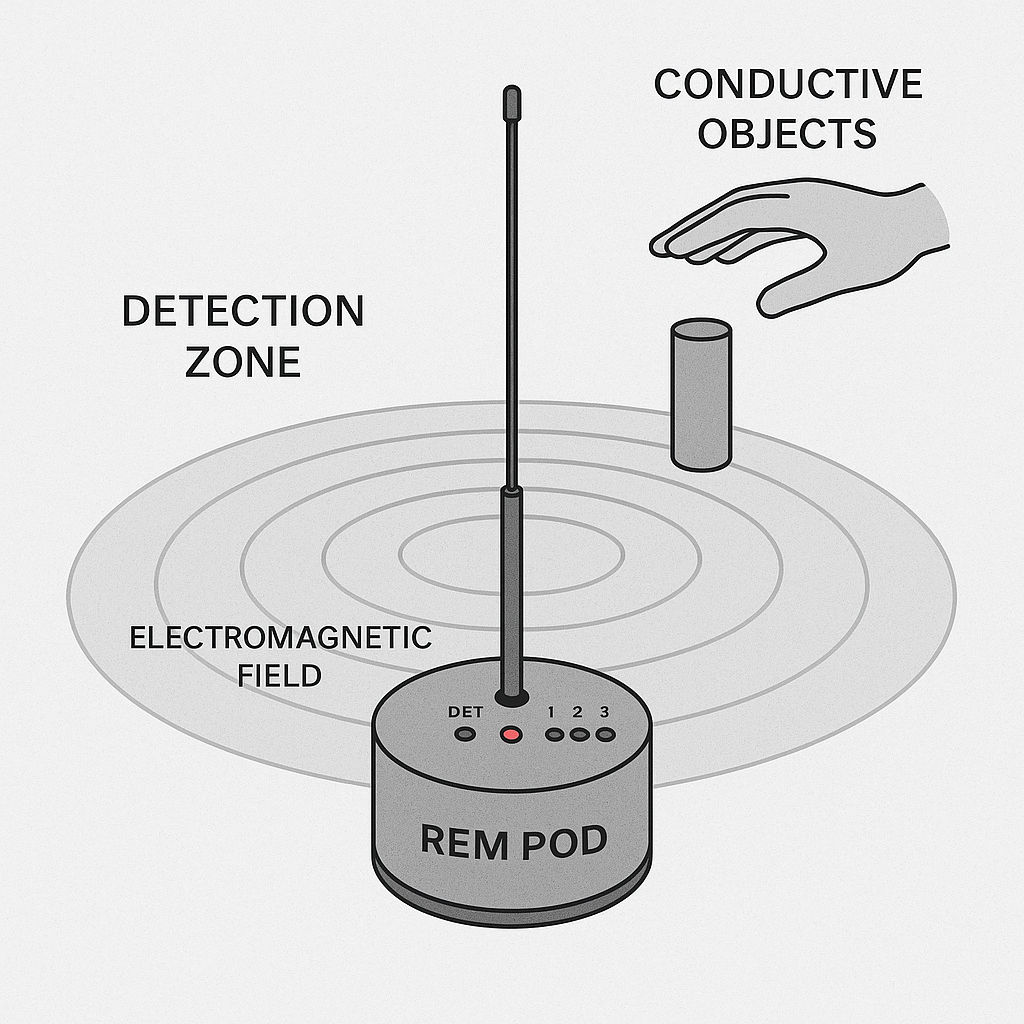
A REM Pod (Radiating Electromagneticity Pod) is a popular device used in paranormal investigation. It’s designed to detect nearby movement or energy disturbances, and it emits sound and light when triggered. The name “REM” refers to Radiating ElectroMagnetic fields.
The REM Pod creates a small electromagnetic field bubble around a telescopic antenna. When something conductive enters or disrupts this field, the device registers a change in capacitance or induction and sets off an alert (usually LEDs and tones).
How It Works (Technically)
1. Electromagnetic Field Emission
The device emits a weak radio-frequency (RF) electromagnetic field, typically in the MHz range. This field radiates around the antenna, forming a “detection zone” approximately 20–30 cm in radius.
2. Capacitance and Inductive Coupling
The REM Pod monitors the capacitance and inductance between its antenna and the surrounding air. When a conductive object (like a human hand, camera casing, or even humid air) enters the field, the capacitance increases.
This change alters the resonant frequency of the circuit — usually a tuned LC oscillator — which the microcontroller detects as a disturbance.
3. Audible/Visual Feedback
When the disturbance exceeds a threshold, the circuit activates LEDs and sound tones, often in different colors or pitches to indicate intensity or proximity.
Field Characteristics
| Parameter | Typical Value | Function |
|---|---|---|
| Field Type | Near-field RF (electrostatic & inductive) | Detection bubble |
| Frequency Range | 200 kHz – 5 MHz (varies by design) | Radiated field |
| Detection Distance | ~20–50 cm | Depends on sensitivity & humidity |
| Response Time | Instantaneous | Continuous monitoring |
| Power Source | 9V battery | Stable supply required |
The field strength is extremely low — safe for humans — but easily affected by metal objects, humidity, static charge, and body proximity.
Physics Behind REM Pod Triggers
The REM Pod operates in the near field, where electric and magnetic components are not yet coupled into a traveling electromagnetic wave.
- In the near field (below ~λ/2π distance), the dominant interaction is capacitive coupling.
- A hand or metallic object behaves like a parasitic capacitor, altering the oscillator’s frequency.
- The change is often non-linear — meaning sensitivity increases dramatically near the antenna tip.
This makes REM Pods inherently sensitive to human presence, conductive surfaces, and environmental conditions, not necessarily to unknown “energy” sources.
The Paranormal Theory
Many investigators claim that REM Pods react when spirits or entities enter the field. The belief is that non-physical presences can influence EM fields or discharge ambient energy, causing measurable changes.
However, no empirical data supports this theory under controlled conditions. Laboratory tests show that every trigger can be recreated using known conductive or electrostatic influences.
Examples:
- A metal chair leg nearby can trigger it.
- Air ionization from heating systems or humidity changes alter capacitance.
- Investigators’ own body fields (especially if grounded differently) cause activations.
Limitations and False Positives
1. Environmental Sensitivity
- Humidity increases conductivity of air, causing spontaneous false alarms.
- Air currents or HVAC systems can slightly move grounded metal objects, altering the field.
2. Human Proximity
Even when “hands-off,” the human body acts as a large conductive capacitor. Your mere presence, particularly if moving or leaning, changes field geometry.
3. Electrostatic Discharge (ESD)
Static charge on clothing or equipment can discharge through the air, causing the REM Pod to trigger. This is especially common on carpeted floors in dry air.
4. RF Interference
Nearby transmitters (walkie-talkies, phones, Wi-Fi, Bluetooth) can couple into the circuit. These cause oscillation detuning and produce identical visual/audible effects.
5. Temperature Drift
The LC oscillator and voltage reference inside the Pod can drift with temperature, slowly altering the “baseline” sensitivity.
How to Test and Calibrate
A proper REM Pod calibration includes the following:
- Measure background EMF (with a calibrated TriField or RF meter) before activation.
- Test known triggers: approach with a grounded probe, an insulated hand, and a metal object.
- Record distances and angles at which the Pod activates.
- Repeat after 10 minutes to account for drift and humidity change.
- Use a grounded shield (Faraday mesh) to confirm it is reacting to field disturbances, not random RF noise.
Recommended Field Setup
| Step | Action | Purpose |
|---|---|---|
| 1 | Place on insulated, non-metallic surface | Prevent grounding loops |
| 2 | Keep 1m clear zone | Reduce false positives |
| 3 | Power via fresh, isolated battery | Prevent voltage noise |
| 4 | Disable Wi-Fi/phones nearby | Eliminate RF coupling |
| 5 | Record with synchronized video/logging | Correlate activity |
Comparison: REM Pod vs EMF Meter
| Feature | REM Pod | EMF Meter |
|---|---|---|
| Field Type | Self-generated RF bubble | Measures ambient fields |
| Trigger Principle | Capacitance / Inductive | Magnetic flux density |
| Output | Audio + Light (qualitative) | Numeric (quantitative) |
| False Positives | High | Moderate |
| Scientific Validity | Low | Moderate–High |
Scientific Evaluation
From an electronics standpoint, the REM Pod is a proximity sensor — not an energy detector. Its mechanism is nearly identical to:
- Theremin antennas
- Capacitive touch sensors
- RF detuning probes
It’s extremely sensitive to physical and electrical interference, making it a poor instrument for evidence collection without strict controls.
In peer-reviewed EM measurement, the REM Pod has no calibrated output, no defined sensitivity curve, and no isolation between magnetic, electric, or RF components.
Therefore, readings cannot be compared, repeated, or verified scientifically.
Best Practice in Paranormal Research
For most investigations, it is simply not possible to conduct strict practices to imminimate all known possible false positives. Such a setup would take many hours out of an investiation. We would therefore recommend to focus on the following, best practice
- Establish environmental control (turn off phones, routers, etc.)
- Document every activation with a timestamp, nearby motion data, and EMF baseline.
- Use redundancy — multiple Pods or different sensors in the same area.
- Attempt replication — see if a human or object movement recreates the response.
- Use hummidity sensors – rule out high or changing humidity using a sensor.
- Use new batteries – Always use new, fully charged batteries. REM Pods are known to activate randomly when battery levels are low, so replace batteries before each session to rule out false activations.
Confirmation:
Never rely on a single method to assume paranormal activity. Always seek corroborating evidence such as EMF spikes, thermal changes, sounds, visual cues, or unusual smells.
 UK Paranormal eXperience
Leave a comment