EMF and Ghost Detection: A Technical Guide for Serious Investigators
This article is written for teams who want to bring rigor to paranormal fieldwork. It explains what electromagnetic fields (EMF) are, why some ghost-hunting tools mislead, what instruments are genuinely useful, and how to design investigations that can withstand scrutiny.
What Is EMF?
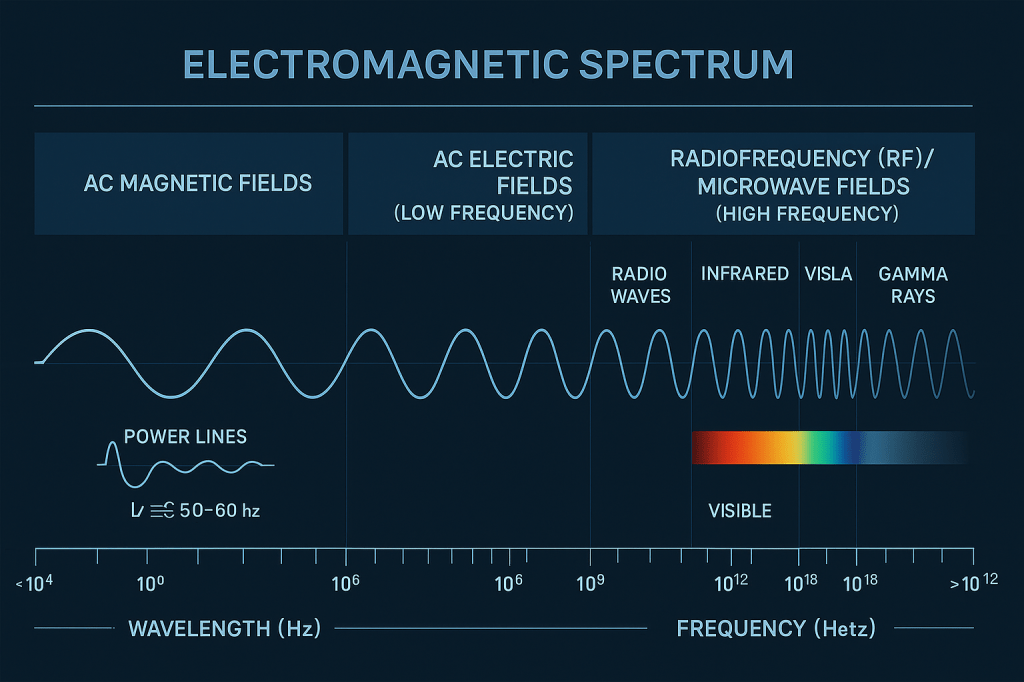
Electromagnetic fields (EMF) arise wherever electric charges are present or moving. In practice you’ll encounter three practically distinct categories in the field:
Magnetic Fields (low frequency, “power-frequency”)
What it is: Produced by alternating currents (e.g., 50 Hz mains in the UK) in wiring, transformers, motors, chargers.
Units: tesla (T) or gauss (G). Field meters typically display microtesla (µT) or milligauss (mG) (1 µT = 10 mG).
Behaviour: Falls off rapidly with distance from the source (roughly with the cube of distance for point-like sources). Materials like steel can guide (but not block) magnetic fields.
Electric Fields (low frequency)
What it is: Produced by voltage on conductors (even without current), from live wiring, extension leads behind plaster, ungrounded metalwork, etc.
Units: volts per metre (V/m).
Behaviour: Can be reduced by shielding and by proper earthing. Drops with distance and with barriers that are connected to ground.
What it is: Wireless transmissions and leakage from electronics: Wi-Fi (2.4/5 GHz), Bluetooth, 4G/5G (e.g., 800/900/1800/2100/3500 MHz bands), DECT phones, smart meters, broadcast radio/TV, walkie-talkies, alarm systems.
Units: power density (W/m² or mW/m²), sometimes as field strength (V/m) or received power (dBm).
Behaviour: Reflects off walls/metal, creates hot spots, bursts in short packets (e.g., mobile phones). Frequency-selective tools are needed to interpret it.
Note on static fields: Earth’s static (natural) magnetic field (~50 µT in the UK) is ever-present. Most “ghost meters” are blind to static fields; they only respond to changes. Serious magnetometers can measure static and dynamic components separately.
The Theory Behind Ghosts and EMF (What’s Claimed vs. What’s Known)
Common Theory
Apparitions or entities manipulate EMF, and spikes can indicate presence.
Intentional communicatio” occurs by asking yes/no questions and watching LEDs.
Scientific Reality Check
Be Aware: There is no replicated, peer-reviewed evidence that anomalous consciousness generates EMF signatures distinguishable from normal environmental sources.
Human perception is sensitive to EMF indirectly:
Time-varying magnetic fields can induce tiny currents in the retina/brain producing magnetophosphenes (flickers) at certain frequencies/strengths.
Transcranial magnetic/electrical stimulation can alter perception, but those field strengths are far above typical ambient levels.
RF interference can produce audible artefacts in poorly shielded audio gear (“GSM buzz”), which can be misinterpreted as voices or knocks.
Psychological factors (expectation, suggestion, ideomotor effects) and environmental factors (infrasound, CO₂, drafts) strongly modulate reports of presence or dread.
Bottom line: If you measure EMF anomalies, you must first exhaust conventional explanations (wiring, appliances, wireless, metalwork, weather, investigator electronics) before inferring anything paranormal.
Why K-II/K2 Meters Should Not Be Used for Ghost Hunting
The K-II (often written K2) is popular because it’s cheap and flashy. It is also not a scientific instrument. Key issues:
Uncalibrated LED bar: No numeric output, no units, no calibration certificate, no error bounds. You can’t compare readings across time or teams.
Broadband, frequency-indiscriminate response: It lights up from a wide swath of RF and low-frequency noise without telling you what frequency or how strong.
Highly susceptible to RF bursts: Mobile phones (even on airplane mode while scanning for towers), walkie-talkies, DECT handsets, Wi-Fi beacons, smart watches, car key fobs—all can trigger LEDs intermittently. Investigators often carry these devices.
No logging or timestamps: You can’t correlate spikes with other sensors (temperature, video, investigator movements) after the fact.
Poor shielding & orientation effects: Hand position, body coupling, and nearby metal objects change the response. Repeatability is poor.
No static field resolution: Can’t measure Earth-field variations or slow drifts.
Result: The K2 generates false positives, encourages post-hoc storytelling, and prevents meaningful peer review. If you want credibility, retire it.
More Reliable Detectors (and How to Use Them)
1) TriField Meter (e.g. TF2), or Advanced GQ EMF-390 Multi-Field Electromagnetic Radiation Detector
What it does: Measures all three: AC magnetic (mG/µT), AC electric (V/m), and RF (mW/m²), with numeric display.
Strengths: Quick triage in unfamiliar sites; switchable modes; basic data logging (depending on model); more repeatable than toy devices.
Limitations: Still broadband in RF—can’t identify which transmitter. Use as a screening tool, not your only instrument.
2) Dedicated Gaussmeters / Magnetometers
Single-axis or three-axis low-frequency magnetic field meters with known bandwidth and sensitivity.
Use case: Mapping 50 Hz magnetic fields from wiring, transformers, elevator motors; capturing transient events.
Advanced:Fluxgate magnetometers can measure static and dynamic fields precisely (including subtle geomagnetic fluctuations).
3) Electric Field Probes (LF)
Use case: Detecting high AC electric fields from live but unloaded wiring, hidden cables behind walls, or poorly earthed fixtures.
Pair with a non-contact voltage tester and an outlet tester for building safety checks.
4) RF Spectrum Analyzers or SDRs
Handheld spectrum analyzer (or software-defined radio, SDR) with an appropriate antenna gives frequency-resolved information: you can see if the spike was Wi-Fi, a phone uplink, a walkie-talkie, or broadcast radio.
Why it matters: Frequency + time signature is how you rule out mundane sources. Record waterfall plots and timestamps.
5) Environmental Data Loggers
Temperature, humidity, pressure, CO₂/CO, infrasound, and vibration sensors help separate environmental shifts from activity.
Synchronize clocks across all devices (video, audio, EMF, environment).
6) Audio/Video with Timecode
Use timecode or NTP-synchronized timestamps so EMF events line up with AV evidence. Shield audio gear; use ferrites on cables to reduce RF ingress.
Field Protocol: How to Check and Rule Out Other EMF Sources
Pre-Investigation Survey
Site interview & map: Note consumer unit location, sub-panels, distribution boards, meter cupboards, known cable runs, trunking, and risers.
Infrastructure inventory: Wi-Fi routers, access points, boosters; DECT bases; security systems (RF sensors/cameras); lifts; pumps; dimmer circuits; neon signs; HVAC; induction hobs; smart meters; solar inverters; EV chargers.
Power quality snapshot (if available): Look for harmonics, switching supplies, and large loads cycling.
Baseline Measurements
Magnetic (LF): Map rooms on a 0.5–1 m grid at 0.5 m and 1.5 m height; record µT/mG. Expect elevated fields near floor-level ring mains and near distribution boards.
Electric (LF): Measure V/m near walls, outlets, pendant lights, and ungrounded metal fixtures.
RF: Walk test with RF meter; note hotspots. Use a spectrum analyzer stationary for 10–20 min to capture duty-cycled sources.
Static magnetics: If equipped, log the static field for at least 15 min to understand natural variation.
Active Controls During Sessions
Airplane mode ≠ RF-silent. Fully power down or Faraday-bag all mobiles/smartwatches. If you must keep comms, use a dedicated channel and log transmissions.
Kill or log major loads: Agree with owners which circuits can be isolated safely. If you can’t turn off, log when HVAC, lifts, pumps, or fridges cycle.
Distance from cables: Avoid leaning meters on walls/floors; maintain consistent standoff.
Instrument orientation: For single-axis probes, capture all three axes or slowly rotate; for tri-axial meters, note the axis summation behaviour.
Grounding and body coupling: Keep your body from acting as an antenna—use tripods or insulated grips.
Source Elimination Checklist
Hidden mains runs behind lath & plaster or drylining.
Dimmers (triac chopping), LED drivers, phone/laptop chargers (SMPS).
Walkie-talkies (your own team!), key fobs, remote shutters.
Nearby masts or repeaters; venue Wi-Fi mesh backhaul.
Metal stairwells/handrails acting as antennas or waveguides.
Static charge build-up on carpets and synthetic fabrics (discharge clicks).
Weather: lightning in the region, solar storms (geomagnetic activity) if you use sensitive magnetometers.
Data Quality: Making Your Evidence Reviewable
Calibration & traceability: Use instruments with calibration certificates (annual or per manufacturer guidance). Record serial numbers and last cal date in your case file.
Logging & timestamps: If your meter can log, enable it. If not, film the display with a timestamped camera.
Metadata: For every notable reading, capture date/time (UTC and local), position (sketch + photos), height, orientation, instrument settings, and team activity.
Repeatability: Try to recreate the anomaly. If it recurs at a location/height/orientation and correlates with a known transmitter or load cycle, it’s not paranormal.
Blind periods: Consider “quiet” intervals where one team member manipulates known sources in another room per a prearranged schedule unknown to the meter operator; check whether EMF spikes match the schedule.
Interpreting EMF in Allegedly Haunted Locations
Old buildings often have mixed wiring (old junctions, knob-and-tube equivalents, spurs) and poor earthing → elevated electric fields and odd magnetic gradients.
Hotels/asylums/hospitals have lift motors, pump rooms, nurse-call systems, and thick cabling trunks producing structured magnetic fields—easy to mistake for “pathways.”
Castles and metalwork create RF reflections and standing waves; hotspots can move if doors open/close.
Cemeteries and rural sites can be quiet electromagnetically—great for control sessions, but beware nearby farms (electric fences pulse at ~1 Hz RF spikes).
Modern homes with solar PV + inverters + smart meters are RF-busy even late at night.
Unresolved EMF events (cannot yet explain; list next tests).
Non-EMF phenomena (audio knocks, sensations) that did not co-occur with EMF changes—state that explicitly.
Frequently Misunderstood Points
“EMF spike = ghost.” Most spikes are explainable with RF bursts or load changes. Use meters that exclude RF such as Trifield and other more professional EMF meters.
“Airplane mode makes phones safe.” Not reliably. Phones still emit while negotiating networks or via Wi-Fi/Bluetooth unless fully off. Use meters that exclude RF such as Trifield and other more professional EMF meters.
“Shielding everything proves it’s paranormal.” Shielding changes the environment; it can create artefacts. Document what was shielded and how.
Schumann resonances (≈7.83 Hz) are extremely weak; your handheld meters won’t detect them.
Static vs. AC fields: Many ghost gadgets read only changing fields and ignore static geomagnetic shifts entirely.
A Practical Plan
For most investigations, it is not feasible to implement strict procedures that eliminate all known potential false positives. Doing so would consume many hours of an investigation. Therefore, we recommend focusing on the following best practices.
Equipment: Use reliable and trusted instruments such as the Trifield TTF2, which can separate and measure the three electromagnetic bands.
Baseline Mapping: Take initial baseline readings to understand and document normal electrical sources in the environment before beginning your investigation.
Magnetic Fields: Where possible, focus on magnetic fields. These are generally less affected by electrical wiring or radio waves from devices such as mobile phones.
Device Control: Before starting an EMF session, turn off all RF-emitting devices — completely shut down phones, two-way radios, smartwatches, and similar electronics to prevent interference.
Movement: Ideally, EMF testing should remain static, with devices mounted on tripods and positioned away from people and walls. If movement is necessary, move slowly and steadily to reduce noise and false readings.
Replication: Attempt to replicate any anomalies. If the effect can be repeated and traced to a mundane source, document it and close the case.
Confirmation: Never rely on a single method to assume paranormal activity. Always seek corroborating evidence such as REM Pod triggers, thermal changes, sounds, visual cues, or unusual smells.

 UK Paranormal eXperience
Leave a comment